
CUTTIN'
HEADS
THE CROSSROADS INFERNO - A NEW MUSICAL
ABOUT
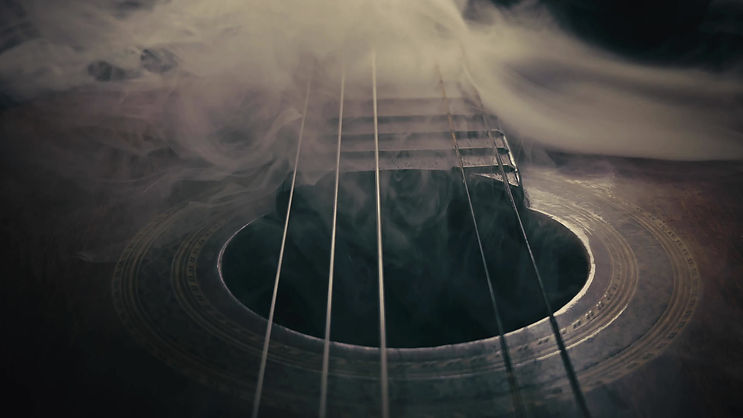
A barbershop at the edge of the crossroads. A guitar that still hums with hellfire. A boy chasing sound, a man haunted by it.
Cuttin' Heads: The Crossroads Inferno is a new original musical that fuses the mythic crossroads legend of Delta bluesman Robert Johnson with the timeless architecture of Dante’s Inferno. Set in a Southern Black barbershop, part sanctuary, part storytelling chamber; the musical follows Robert Johnson as he embarks on a journey through a surreal underworld to reclaim his sound, his soul, and his legacy.
As Robert navigates the nine circles of a musical hellscape, he’s guided by Miss Bess, a no-nonsense blues queen rooted in the spirit of Bessie Smith. In the living world, a young boy named Plug watches and listens, slowly absorbing the rhythm of rebellion, artistry, and transformation that flows through the clippers, chords, and chaos of the barbershop.


A preview Told in Rhythm and Flame
At its core, Cuttin' Heads is a journey of voice: who gets to shape it, who tries to silence it, and how it echoes through generations. From whispered prayers to shouted gospel, from bottleneck slide to electric distortion, the music of this show carries the tension of tradition and change.
Blues, gospel, rock, and spoken word collide with Southern folklore, Black barbershop culture, and the spiritual weight of legacy.
CHARACTERS
 |  |  |  |
|---|---|---|---|
 |  |  |  |
CHARACTER DESCRIPTIONS
ROBERT JOHNSON
Black man | 20s–early 30s | Lead / Protagonist
Gifted, grieving, charismatic, flirtatious, competitive, stubborn, ambitious, vulnerable, and musically magnetic. A young blues guitarist carrying the deaths of his wife Virginia and their child like a stone in his chest. Robert wants to become the greatest bluesman alive, partly for glory and partly because he believes music might carry him back to the people he lost.
BESS
Black woman | 30s–50s | Lead / Guide
Regal, sensual, queer, witty, worldly, fearless, protective, and musically commanding. A blues spirit who has already been through Hell in life and knows the roads below better than most souls know the roads home. Bess can seduce, joke, cut, comfort, and challenge in the same breath. She becomes Robert’s guide and fiercest advocate, refusing to let any gatekeeper convince him that pain makes him property.
COUSIN HEAD
Black man | 40s–60s | Lead / Parallel Protagonist
Wise, funny, observant, proud, grounded, protective, sharp-tongued, and deeply rooted in community. The owner and heartbeat of Head’s Barbershop. To Head, the shop is a bass line: steady, low, necessary, and holding everybody together whether they notice it or not. While Robert fights for his soul below, Head fights for a place in the community above.
PAPA LEGBA
Black, Afro-Caribbean / African Diasporic | 40s–70s or ageless | Man or masculine-presenting spirit | Narrator / Trickster / Gatekeeper
Otherworldly, playful, menacing, seductive, philosophical, mischievous, theatrical, and impossible to pin down. Papa Legba stands where roads meet and choices split. He bends time, slips between worlds, speaks in riddles, and reminds everybody that every bargain is a choice. Neither simple villain nor savior, he keeps the gate, tests the traveler, and threads the musical together with one warning: as above, so below.
MR. DWIGHT SAMUEL WILEY
White man | 50s–70s | Antagonist / The Devil
Controlled, entitled, calculating, charming when it serves him, and dangerous when charm stops working. Wiley is a businessman who treats debt like a leash and opportunity like bait. He uses property, paperwork, police, intimidation, and false generosity to keep others indebted.
PLUG
Black boy | 7–10 | Featured Child / Symbol of the Future
Curious, observant, funny, eager, impressionable, and fascinated by music. Miss Hippie’s seven-year-old son watches the grown folks more closely than they realize. He studies Robert’s guitar, Head’s wisdom, Junebug’s choices, Wiley’s power, and his mother’s survival. Plug is the next crop, the child standing at the edge of the field waiting to inherit whatever this generation decides to plant.
JUNEBUG
Black man | 20s–early 30s | Supporting
Charming, impulsive, flirtatious, funny, prideful, sensitive, restless, and hungry to prove himself. Head’s young barber apprentice wants money, respect, women, and adulthood all at once. He turns to anger when the world reminds him how little power he actually holds. Junebug is a young man standing at his own crossroads, still deciding whether hurt will become wisdom or violence.
MISS HIPPIE
Black woman | late 20s–40s | Supporting
Sexy, savvy, playful, resilient, resourceful, protective, flirtatious, and quick-witted. Plug’s mother knows how to survive a world that is always watching, judging, pricing, and talking about women like her. She knows when to flirt, when to hustle, when to laugh, and when to protect her child. Beneath the town gossip is a woman making a way out of no way.
VIRGINIA
Black woman | 20s–30s | Featured / Memory
Tender, luminous, graceful, haunting, and emotionally resonant. Robert’s deceased wife is less a ghost than a pull, the love at the root of everything he does. She lives in his memory through water, movement, music, color, and absence. Robert begins the journey desperate to reach her; his final willingness to wait becomes proof that grief no longer owns every choice he makes.
BILL
White man | 30s–60s | Featured
Reflective, plainspoken, morally defiant, conflicted, and principled. Bill carries an inheritance he refuses to accept as destiny. His decision to go against the grain expands the musical’s central question beyond Robert: what do we owe the people who came before us, and what are we allowed to refuse? He represents the possibility of breaking a poisonous inheritance instead of passing it down.
BARBERSHOP QUARTET / ENSEMBLE
Predominantly Black ensemble, with White roles as required by the world of the play | 20s–70s+ | All genders
Rhythmic, transformational, vocally strong, physically expressive, funny, dangerous, and ever-present. They are the pulse of the Delta and the souls of Hell: barbershop patrons, gossipers, musicians, dancers, sinners, demons, police, Klan members, witnesses, and community. They shift the world around Robert and Head, becoming the human chorus that makes the musical’s central truth visible: what happens above has an echo below.
JENNINE
"DOC" KRUEGER
ALTON
JAMES
BOOK & LYRICS
COMPOSER

.jpg)
Jennine “DOC” Krueger is a mother, writer, musical-theatre creator, poet-lyricist, artivist, public speaker, and educator based in Atlanta, Georgia, where she is pursuing an MFA in Film and Television at the Savannah College of Art and Design (SCAD).
She is a 2026 National Fellow with the Dramatist Guild Foundation, and also a current Theatre Now New York Musical Development Lab Member. Her work blends hip-hop, history, folklore, and social justice into bold, genre-bending musical storytelling that puts marginalized voices front and center, where they belong.
Her hip-hop musical Green, a remix of Sir Gawain and the Green Knight filtered through Chaucer’s Canterbury Tales, is currently in development with Theatre Now New York’s National Musical Development Lab. She is also developing new musicals centered on Doris Miller, a Black WWII hero, and a reframed Salem Witch Trials story told from the perspective of Tituba. Her current musical focus, Cuttin’ Heads, is a blues-soaked, 1930s barbershop musical rooted in the legend of Robert Johnson at the crossroads, harmonizing urban folklore with a descent worthy of Dante himself.
Poetry is her first language and primary medium.
A nationally recognized poet, Jennine has earned multiple slam titles, coached national teams, and mentored writers in performance and dramatic storytelling. Her dramatic work has won Best of Fest five times at FronteraFest in Austin, and she was previously nominated for a Pushcart Prize in Good River Review. Her anime screenplay pilot Ars Poetica, a poetry-powered exploration of mental health, won Best TV Pilot at the Tokyo Screenwriting Festival.
Her filmography explores mental health, where she writes, directs and enjoys the creative process around pitching and development, creative producing, wardrobe and set design.
An HBCU alumna of Huston-Tillotson University, Jennine holds an M.Ed. from Concordia University and an MFA in Poetry from Spalding University.

Alton James, Ph.D., MBA, is a composer, multi-instrumentalist, vocalist, producer, and interdisciplinary sound artist whose work explores the places where music, story, memory, and human experience converge. He is currently serving as composer for an original theatrical work by playwright Jennine Krueger. Through original works and premieres, James approaches music not merely as accompaniment, but as a dramatic language—one capable of illuminating the inner lives of characters, carrying what words leave unspoken, and shaping the emotional architecture of a story.
His creative practice spans theater, television, film, games, and recorded music, encompassing the full production and post-production process. His work includes composition, arranging, recording, music production, editing, mixing, mastering, Foley, sound design, and immersive audio. Working from his 9.1.6 Dolby Atmos studio, James creates dimensional sonic environments in which music, dialogue, movement, silence, and atmosphere become part of a unified narrative experience. His background as a pianist, keyboardist, vocalist, and multi-instrumentalist informs the harmonic and emotional character of his compositions. At the same time, his technical experience allows him to carry an artistic vision from its earliest musical idea through its final immersive presentation.
James’s artistry is further shaped by his work as an educator, scholar, and higher-education leader. His academic foundations in English, music, history, education, public policy, business, technology, and organizational leadership deepen his sensitivity to language, culture, character, and the social worlds from which stories emerge. These disciplines do not exist separately within his practice; they continually inform one another, joining imagination with inquiry, musicianship with technology, and emotional intuition with intellectual rigor. Across every medium, James seeks to create work that is sonically evocative, narratively purposeful, and attentive to the full humanity of the people whose stories it carries.
